Practice
AI and automation that survive an audit
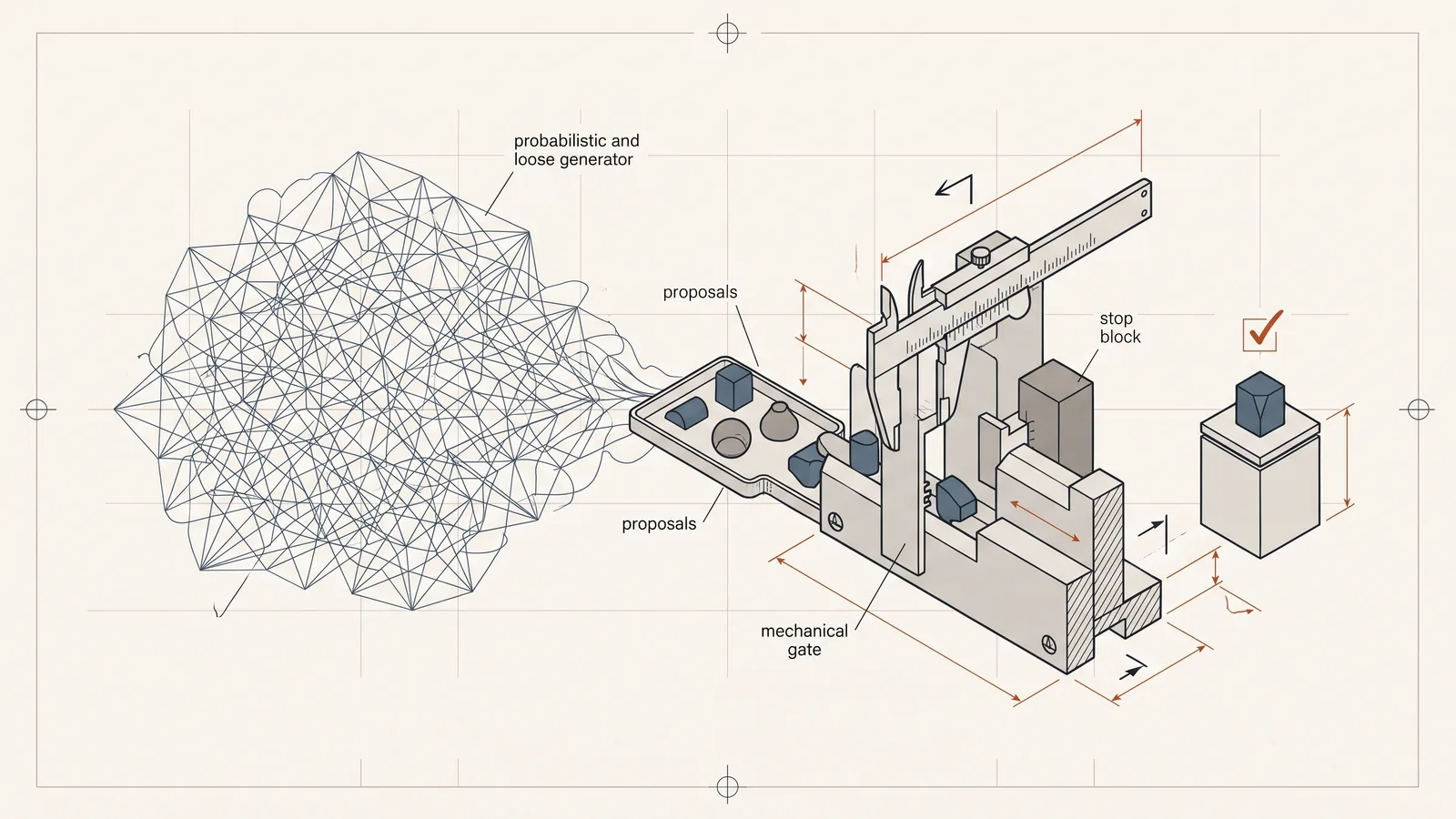
A language model is an excellent generator of proposals and a poor place to make decisions. I build systems where AI proposes, deterministic code rules, and a person approves anything that leaves the organisation.
How I look at it
Most failed AI deployments are not caused by a weak model but by three unanswered questions: who carries the consequence of an error, where the quality gate sits, and what it costs at production volume. I start there, because those answers determine the architecture, not the choice of model provider, which will change its pricing or retire a version within the year anyway. I also know from my own invoices that a pilot always looks cheap: regenerating one of my analytical artifacts costs about sixteen million tokens, and I knew that number before deciding to run it on a schedule, not after the bill.
What I have built
I built a company AI hub with six in-house MCP servers, CRM, mail and calendar, ERP, document search, per-user memory, and a WhatsApp gateway that joins one number to five applications: HMAC signature verification, deduplication in Redis, routing by command and session. The cost of every query is visible in the observability layer via OpenTelemetry; a cheap model classifies and filters, an expensive one only synthesises, and repeated questions are caught by a semantic cache on embeddings. In a system verifying label compliance against FEDIAF requirements and EU law, five reliability layers operate, confidence scoring, an independent second reading of the numbers with cross-comparison, thresholds computed deterministically in code, escalation to a human, a fixed test set, and four of the five are not the model. A shelf-exposure audit turned 2,827 photographs from seven markets and 54 retail chains into 26,864 product observations, 86 percent with a price read. Supplier price-list validation cut 8–12 hours of manual work to a few machine minutes plus 15–30 minutes of review, I report both numbers, because they are only true together. In production planning the decision-maker is a constraint solver, not a model. In a recruitment system there are no automatic rejections: every score carries a rationale and a source quotation, and the whole design targets the EU AI Act's requirements for high-risk systems, with a DPIA and defined retention.
What follows
What emerges is a system you can show an auditor and a regulator: the rationale for every suggestion on record, personal data redacted before it reaches a model, and a known unit cost. It costs more at the design stage and demos less impressively, but it does not have to be rewritten when the solution leaves the pilot.