Practice
Business processes and their automation
Automating a process nobody measured encodes its faults in software. I start by counting where the process actually loses time and money, and only then decide what to automate, and what to simply remove.
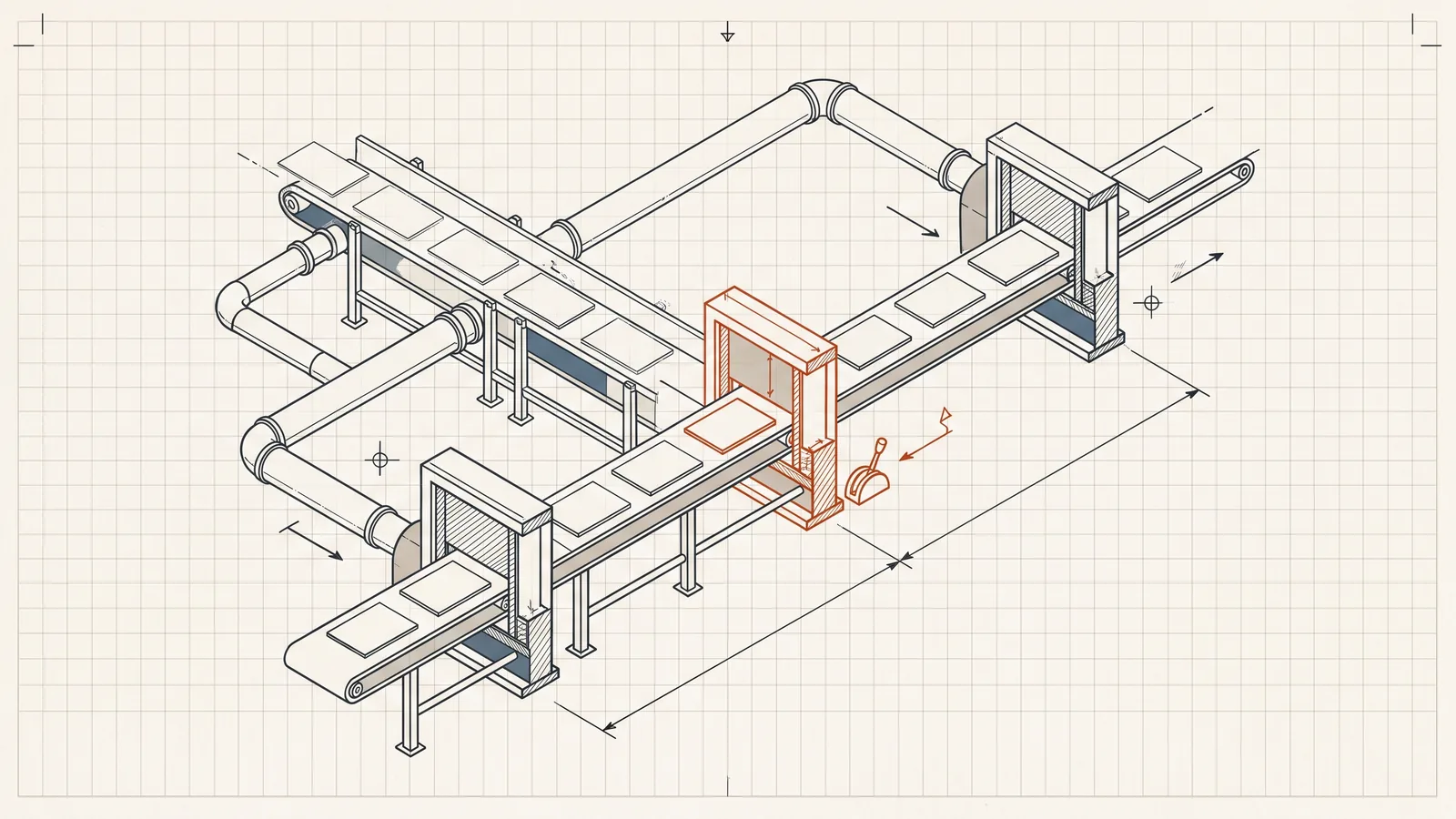
How I look at it
A business process rarely happens where it is documented. The real flow lives in inboxes, spreadsheets and manual bridges between systems, and that is where I measure the cost. In one of my analyses the starting point was counting four manual re-keyings of data between systems, plus the order lines lost because they arrived as free text in a message. Only a list like that settles what to automate first, and exposes the steps that are cheaper to delete than to accelerate.
What I have built
I build systems where the process is executable, not described. Document flow: a BPMN engine with an approval matrix that enforces segregation of duties, SLA timers and escalations. Invoices: full integration with Poland's national e-invoicing system under the FA(3) schema, retrieval per tax ID, a parser hardened against XXE attacks, XSD validation, tax-ID checksum control, treasury whitelist checks, split-payment handling, deduplication, plus a JPK_V7M(3) return generator. Debt recovery as a legal process: from reminder, through an interest note with a versioned central-bank rate and the statutory 40, 70 or 100 euro recovery compensation, to a claim filed with the electronic order-for-payment court over its SOAP interface. Production planning to ISA-95 across four levels, S&OP through RCCP and MPS down to detailed scheduling, with a rolling horizon, plan-freezing zones, and a CP-SAT constraint solver as the decision-maker. ERP integrations go exclusively through an idempotent outbox, because a duplicated accounting event is not a technical glitch but an error in the books.
What follows
Changing the process stops being an IT project and becomes a change to a flow you can see in the data. Every transition leaves a trail, so the process can be accounted for and shown to an auditor. The usual side effect of measurement is a shorter process: once the cost of each step is visible, steps get deleted instead of automated.