Context
A private-label pet food manufacturer with B2B partners across several European countries ran its plant and its sales operation on a set of spreadsheets, email threads and knowledge held in a few people's heads. The demand was not for one system but for a dozen: production planning and monitoring, document workflow, recipe compliance, sales, warehousing, recruitment.
Problem
The instinctive response is to buy a dozen products or to build a dozen applications. Both options run into the same wall. Every application wants its own authentication, its own database, its own deployment, its own notification channel. At ten systems and one team, maintenance starts costing more than the build, and integration becomes a separate product that nobody ordered.
The second difficulty is substantive, because some of these processes are regulated or computationally hard: recipes have to comply with FEDIAF and EU regulation, invoices with KSeF requirements, and the production plan has to respect the real constraints of the lines. These are domains where a result that is "probably correct" is worth nothing.
Approach
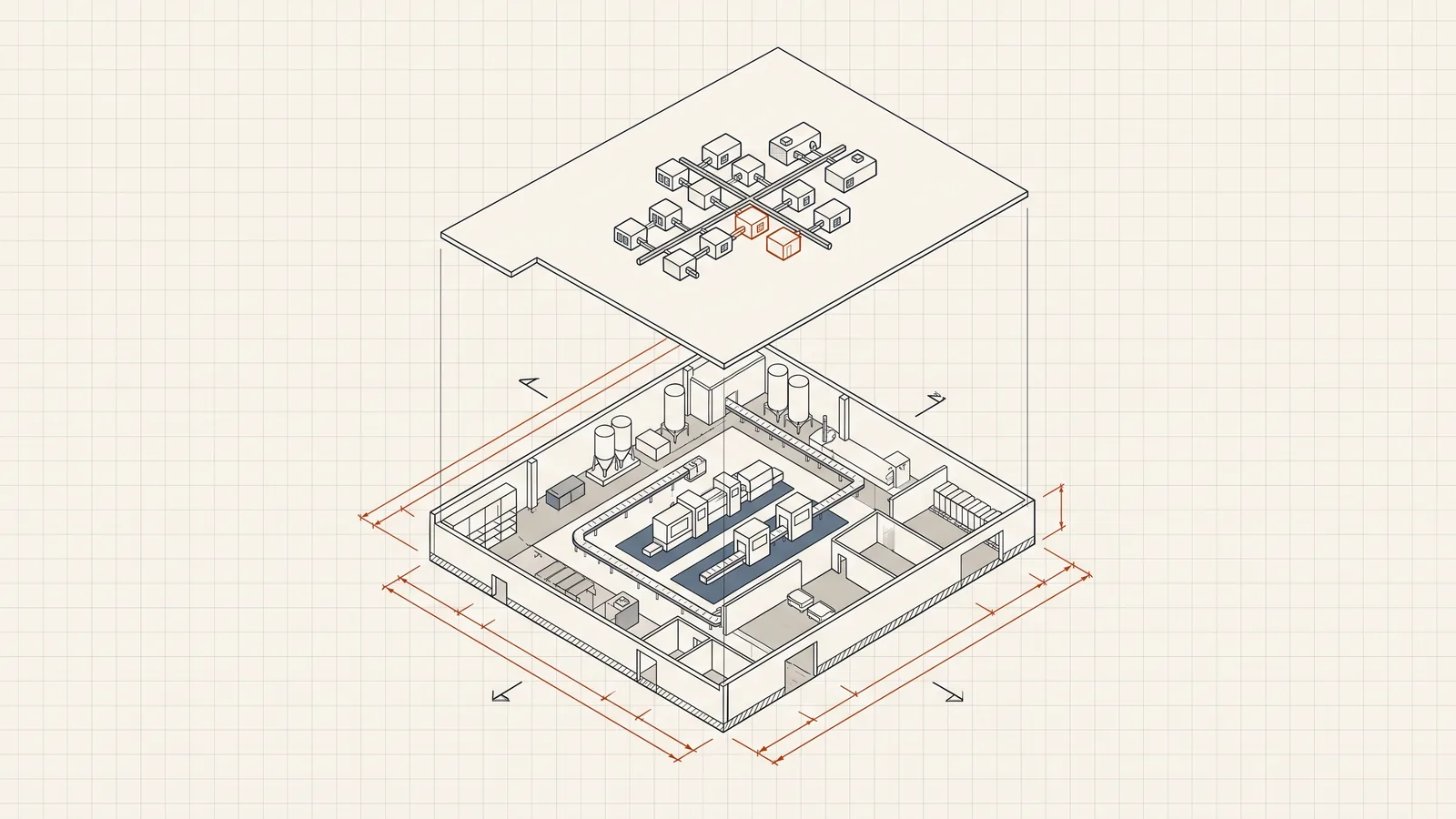
The first decision, ahead of any feature, was the shared layer: one Keycloak with one realm, one PostgreSQL cluster with a database per application, one Redis with allocated database numbers, one reverse proxy, one WhatsApp gateway routing traffic to five applications, one LLM gateway with full cost observability. Every new system receives those as inputs rather than rebuilding them. Bounded context boundaries are justified in ADRs, because without that discipline "reuse" turns, within a few months, into a single monolith carrying ten names.
The production layer is built to ISA-95 (APS/MOM), with data acquisition over OPC UA and MQTT/Sparkplug B and time series in TimescaleDB. Conformance to the ISA-95 model earns its place here, because it is the only way I know of to make the words "resource", "operation" and "order" mean the same thing in a conversation with a controls engineer, in the interface and in the database schema.
One rule governs the AI layer: AI proposes, a person decides. Models read documents, classify, summarise and prepare the decision. Approval stays with a human everywhere the effect is external or regulated. The cost of that rule is explicit: full automation cannot be promised, and every process needs a review queue kept running. So is the gain: no system creates an obligation nobody approved, and each one can be defended in an audit.
Outcome
About ten internal systems run on the shared infrastructure, production planning and monitoring, document workflow with KSeF, recipe compliance in R&D, sales and marketing automation (19 workflows), e-commerce, an ATS. The warehouse system is still being built. All of it is maintained on a single VPS.
Two operational changes can be stated in numbers. Supplier price list validation, previously 8–12 hours of manual work, is now around 5 minutes of processing and 15–30 minutes of human review. The shelf audit turned 2,827 photographs into 26,864 product observations.
What it taught me
A dozen internal systems are not a dozen projects; they are one platform and a dozen features. The decision that settles which of the two you get is taken before the first line of feature code, and it is in practice irreversible later without rewriting every deployment.
The second lesson concerns how far AI reaches in a manufacturing and regulated environment. The limit of usefulness sits where accountability for the outcome begins. Systems that draw that line explicitly get used daily. Systems that do not stay in pilot.