Context
A manufacturing group was preparing several capital projects at once: a grain distillery on an existing plant site, two rendering halls and a small agricultural biogas plant. Each of them needs a building permit design, meaning a site development plan, an architectural and construction design, a technical design, the formal path of decisions and agreements, and the calculations behind all of it. In Poland the form of that documentation is set by regulation, and a licensed designer signs it and carries the liability.
Problem
Design offices bill this work by volume, and most of the volume is not design. It is reading a local zoning plan, establishing which decisions are needed and in what order, carrying room programmes into drawings, checking distances between buildings against fire regulations, and assembling the same facts into a dozen documents that have to agree with one another. When one parameter changes, that agreement is maintained by hand, and that is where it breaks.
The obvious AI answer, a model that drafts the documentation, fails on the property that matters most. A design package is read by people looking for the paragraph each statement rests on. A model that cites building regulations from memory produces paragraph numbers that look right, and a design volume with one invented citation is worse than a blank page, because the reviewer can no longer trust the rest of it.
Approach
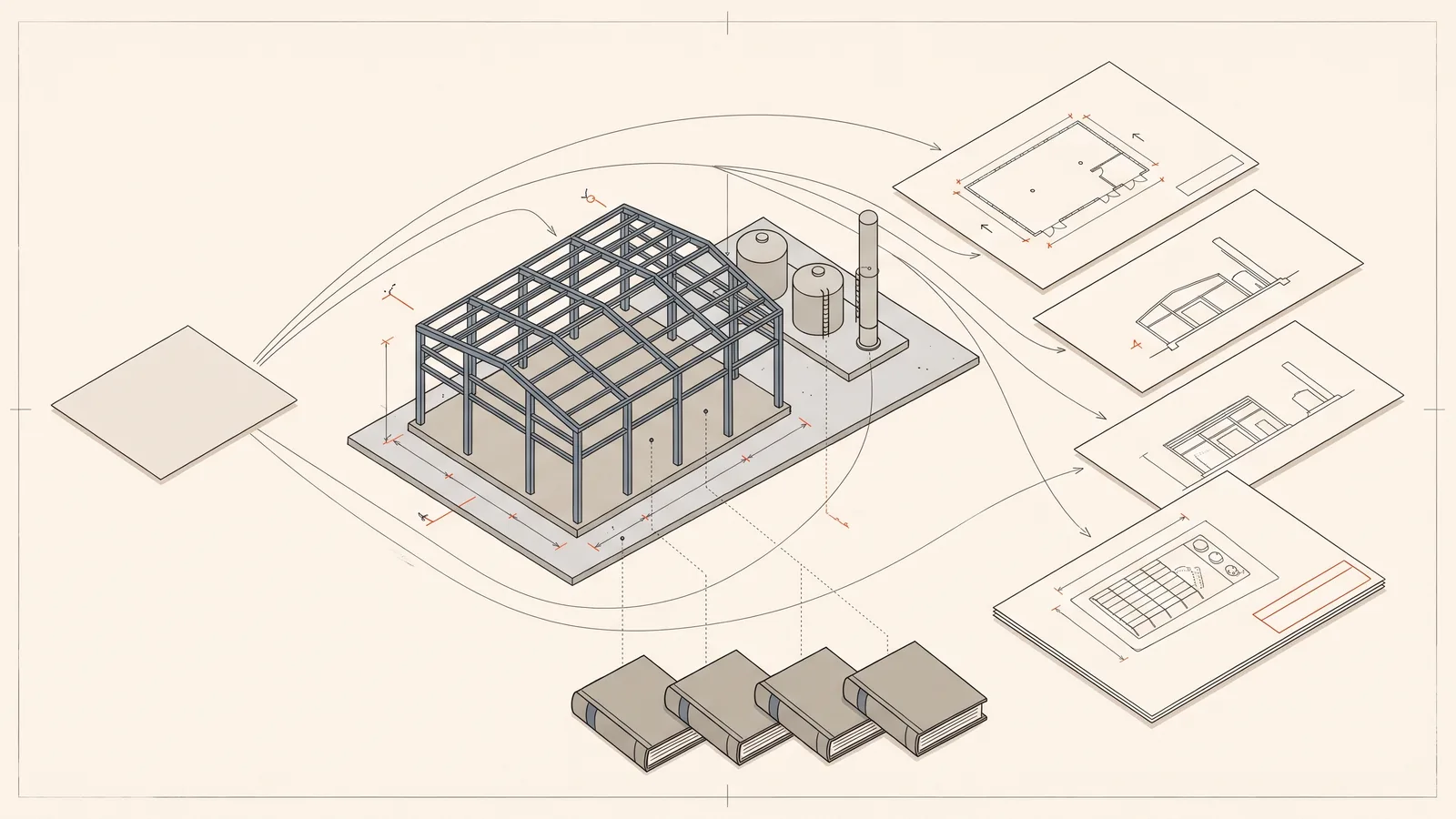
I built the generator around three rules that the code enforces rather than the prompt requests. One source of truth: every drawing, schedule and document is produced from one project file and a knowledge base, outputs are never edited by hand, and changing a parameter rebuilds the whole package. Every number has a source: a process parameter, a distance or a requirement carries a reference to a paragraph of law, to literature or to a manufacturer's datasheet, or it is marked as an assumption and lands in a register on which the designer has to decide. Regulations come only from files: legal acts are fetched from the official legislation API with the date and address, each file names the consolidated text it comes from and the amendments published after it, and the tests find every rule's quoted fragment verbatim in the text of the act. Values from regulation tables live as data with their source, never as numbers in code.
The core knows nothing about a particular kind of building. It handles the plot and the zoning plan, the massing and the IFC model, fire zones, formal triggers, documents and the completeness checklist. Plant knowledge lives in domain modules: a distillery with its mass and energy balance, column sizing, P&ID and explosion zones; a biogas plant with its substrate balance, digester sizing and gas storage matched to the operating windows in the grid connection agreement. A condition on the plant type inside the core is treated as a design error. Cross-consistency is a build gate: a room or equipment tag that appears in a schedule but not in the P&ID or the IFC model stops the build.
Missing data is never guessed. It goes to a list of open items stating which document it blocks and who has to supply it. Paid standards are not reproduced either; a result that needs one is marked as such and left to the designer.
Around the generator sits a web application that takes an employee through seven stages, with checks that come with ready fixes and a preview of their effect before anything is saved. Its copilot takes numbers from the generator, regulations from the legal files and procedures from versioned skills, and proposes changes as cards to approve. The same skills, reviewer subagents and hooks ship as a Claude Code plugin, with evaluation cases such as citing the law without relying on memory.
Before handing anything over I ran an audit of the package and of the generator itself: five independent reviews, each confirming its findings in the code, the legal text or the output file. It found what a designer would have found, among others a module building that failed the zoning check while still feeding the package summary, a utilities balance check that could never fail, and fire road and distance rules applied too narrowly. The fixes went in before the handover, not after it.
Outcome
The distillery pilot reached the designers eleven days after the first commit, as a complete package: drawings held to the standard of an approved permit design used as the reference, an IFC model with a 3D preview, technical descriptions and a verification report. It stands at 173 requirements met, 62 gaps and no errors, with 41 open items, every one of them waiting on someone outside the project, such as the grid operator, the road authority or a geotechnical survey. The rendering halls and the biogas plant run through the same core, and the biogas plant's technical data and schedule of works are meant to feed the loan documentation the group prepares for its bank.
The limits are part of the design. The generator does not sign anything and does not replace the designer's judgement; it moves their work from assembling to checking. It cannot apply a standard it does not hold, and its legal knowledge is exactly as current as the last fetch.
What it taught me
The useful boundary for AI in a regulated discipline is not the model's accuracy but the source of each statement. Once every number and every citation has to point at a file, most of what a model would be tempted to invent has nowhere to go, and what remains is visible as an assumption.
The second lesson is about auditing your own output before someone else does. The reviews found errors the tests had not, because the tests checked what I had thought of, while the audit read the package the way its first reader would.