Context
A warehouse ships several hundred orders a day, and until this project the choice of carton was made by whoever was packing. The two questions put to me were whether software could propose the carton, and whether the cartons actually used could be recorded well enough to reconcile consumption against stock.
Problem
The tempting shortcut in carton selection is volumetric. Add up the volume of the goods, compare it against the internal volume of the box, and accept anything that fits with a margin. It is wrong often enough to matter, and the way it fails is unpleasant: the operator discovers the mistake holding the goods, halfway through a shift, with the packing slip already printed.
The second problem is commercial rather than technical. A project like this is approved on the promise of savings, and the easiest number to produce is cubic decimetres eliminated against a nominal courier tariff. That number is arithmetic performed on assumptions, and it becomes a claim about money only once the products have been measured, the cartons have been measured, the operating rules have been adopted by the warehouse and the tariff has been confirmed. Every one of those was outstanding while the engine was being built.
Approach
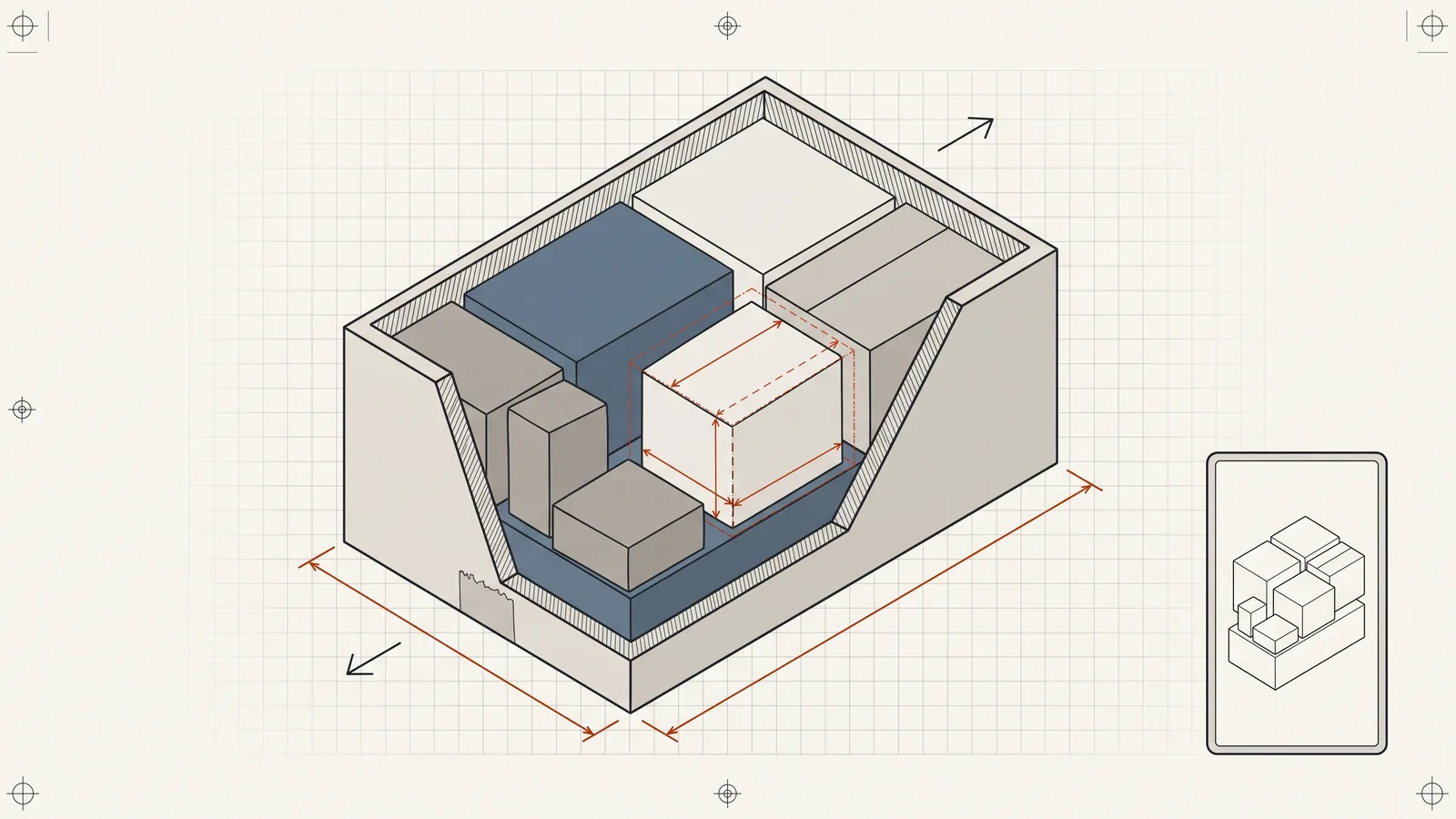
No path in the system accepts a carton on volume. Every item carries an identity taken from its order line, appears exactly once in the result, and comes back with a position and an orientation, so the output is an arrangement that can be drawn rather than a verdict that something ought to fit.
A validator written separately from the solver then checks that arrangement independently: boundaries, collisions between items, permitted orientations, support beneath each item, load transmitted through the stack, and the mass of each finished parcel including its packaging. Soft products provide no support for anything above them, and trays lie flat on their thin edge. Units are handled so that rounding always works against acceptance: input arrives in centimetres and kilograms, the model and the validator work in whole millimetres and grams, product dimensions and masses round up, carton interiors round down.
The status vocabulary carries more weight than it looks. A result marked ready means a complete validated plan on approved data and rules, and it says nothing about optimality. Two statuses describe what a human has to supply, one for review and one for missing measurements. The remaining three separate a demonstrated physical constraint from an exhausted search and from a timeout, and keeping them apart matters because only one of the three gets better when the solver gets better. Collapsing them into a single failure would hide the distinction between a box that cannot work and a box I stopped looking for.
Approval runs over WhatsApp, where the operator receives the proposal with a link to an interactive preview on the phone, which shows the arrangement in three dimensions alongside top, front and side views, reveals whole layers on demand, names the products, counts the parcels already inspected and keeps the decision bar fixed on screen. At the station the operator confirms the carton code for each parcel individually; changing a carton or the way goods are split requires a reason and a fresh validation, and only completing the session records consumption. Corrections, returns and damage create their own events instead of editing history.
Writing back to the order platform is disabled by default, and turning it on requires four separate things to line up: an explicit commit flag on the command, a live-enabled setting in configuration, a verified pagination flag proving the reader has seen complete pages, and a credential holding the writer role. Reader and writer credentials are kept apart, an HTTP 200 is not treated as success until the status field inside the response body has been read, and manual or unrecognised entries in the carton field are protected from overwriting. Where a response is lost, the next attempt reconciles against the platform before it writes, because a lost response says nothing about whether the write landed. Idempotency is keyed on the session and the parcel rather than on the carton code, since two parcels in one order legitimately use the same box. Closing a session, recording consumption and queueing the outbound write happen in one database transaction, so a network failure cannot erase a physical fact.
Outcome
On the first four hundred real orders the engine produced 386 complete geometric plans, 14 results flagged for missing data, and 544 parcels in total. All 386 carry the review status, because the products, the cartons and the policy have not yet been physically measured and confirmed, and the reports say so in those words. The twenty-kilogram parcel limit and the seventy-percent support rule are configurable operating rules that the warehouse has to adopt; the software does not settle legal requirements on anybody's behalf.
The engine, the operator station, the approval route and the HTTPS preview run on a server, and the integration with the carton catalogue is deployed and enabled with the owner's agreement. The reports state processing times and status distributions, and they stop there. A figure for money saved will exist once the measurements are accepted, and not before.
What it taught me
The status a system returns is part of its interface, and a vocabulary that distinguishes causes gives an operations team something to act on. Knowing that a plan needs a measurement, rather than that it failed, turns a software output into a task somebody can pick up.
The second lesson is about the number a project is expected to produce. Reporting a saving that rests on unconfirmed measurements would have been easy, defensible in a slide and impossible to stand behind in a review six months later. Naming which figures are evidence and which are still assumptions costs a little enthusiasm at the start and buys the credibility of every number that follows.