Context
Henomorphs is my own product: a collection of NFTs on Polygon with a game economy attached, and CryptoColony42 is the front through which a player meets it. Under both sits HMS Protocol, the contract layer that holds the collections, the augment system, energy, evolution and the wars that colonies fight over territory. The founding collection, Genesis, is 2,300 tokens in four variants; later ones, Matrix, the augment packs and the colony cards, extend it rather than replace it.
Problem
A game is a design that gets corrected, usually within weeks of players touching it. A public chain is a promise that the rules do not change behind anyone's back. Those two are in direct opposition, and most NFT projects resolve them by picking a side. Either the contract is immutable and the economy is frozen at whatever the team believed on launch day, or the logic sits on a server and the chain holds a picture plus a receipt, in which case the on-chain part is decoration.
There was a second problem underneath. An ecosystem that keeps releasing collections accumulates a choice: does the new drop bring its own contract, its own storage and its own bugs, or does it enter something that already exists? The first route is faster each time and eventually produces a portfolio where nothing composes with anything, tokens cannot be equipped across collections, and every integrator has to special-case five contracts.
Approach
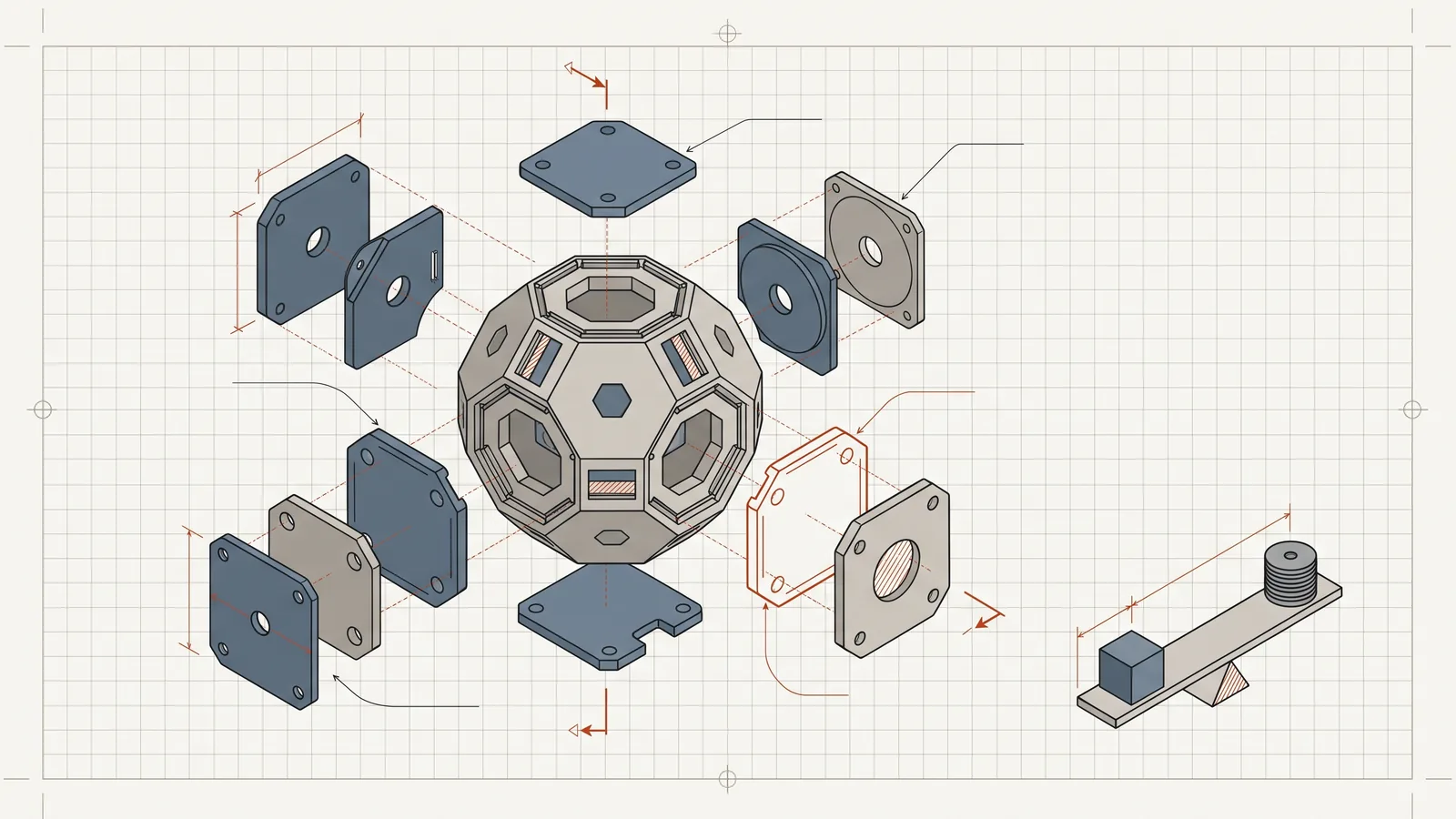
I built the collections on the Diamond pattern, EIP-2535: one proxy that routes calls by function selector into facets, all of them sharing one storage layout. That gives a unit of change smaller than a contract. Battle mechanics live in one facet, alliances in another, energy and evolution in two more; a correction to combat maths ships as a facet replacement rather than as a migration that asks holders to move to a new address. Twenty-one facets sit behind the diamond in the current protocol generation.
Composability was taken from standards rather than invented. Tokens are equippable, nestable and multi-asset per ERC-6220, ERC-7401 and ERC-5773, which is what lets an augment be a token that goes inside another token, and what lets a wallet or a marketplace I have never spoken to render the result correctly.
The economy was split into two tokens because one token cannot serve both purposes. Gameplay rewards have to be elastic, or emission dies; governance and access have to be scarce, or every reward payout dilutes the people holding for the long term. So YLW is the utility token that the game emits and burns, ZICO is fixed supply and buys governance, colony creation and premium access. Staking exists on top, including a receipt token for staked positions so a holder can exit liquidity without unstaking.
Off-chain I kept the split honest: an indexer listens to events and fills a cache, the API reads that cache, and the applications, web and React Native, read the API. Nothing that decides an outcome lives there. If the API disappears, the state is still on Polygon and still verifiable; what disappears is convenience.
Documentation was treated as part of the protocol, not as marketing. Contract addresses, facet inventory, token economics and the composability model are published as a docs site, because an ecosystem meant to be integrated with has to be legible to someone who did not build it.
Outcome
The contracts are deployed and verified on Polygon mainnet, the collections trade on the usual secondary venues, and the ecosystem now has several collections that share one protocol rather than one contract each. The upgrade path has been exercised in practice, which is the only test that counts for a diamond. The ecosystem is live at cryptocolony42.com.
Two of the costs here were accepted knowingly. Upgradeability means holders trust an admin key, and pretending otherwise would be dishonest; the mitigation is that the boundary is documented rather than hidden. And shared storage across facets is unforgiving, a careless struct change corrupts state for every facet at once, so storage layout has to be reviewed with more discipline than ordinary contract code.
What it taught me
The interesting question in an on-chain product is not what to put on the chain but what must never need changing. Everything that will need changing belongs behind an upgrade boundary you designed on purpose; everything else can be immutable and should be. Deciding that late means deciding it during an incident.
The second lesson is that standards are cheaper than they look. ERC-6220 and its neighbours cost more to implement than a bespoke equipment system, and they pay for themselves the first time an external marketplace displays a composed token correctly without anyone integrating anything.