Context
JDG Księgowy is an open-source accounting assistant for a Polish sole proprietorship, written for the monthly cycle that actually exists: issue invoices, send them to KSeF, book costs, work out ryczałt, ZUS and VAT, produce a JPK and submit it, and once a year file PIT-28. It runs self-hosted, and it can run against a local model.
Problem
Accounting software for the smallest businesses is a solved market, and it is solved by SaaS that owns the data, charges monthly and makes the user drive a form. The gap was never about features. What was missing is that the work is conversational in shape, "invoice Acme for April", and transactional in consequence, a document that either satisfies a schema published by the Ministry of Finance or is rejected.
That gap is exactly where AI assistants are weakest. A language model is very good at producing an invoice that reads correctly and quite capable of producing one that fails XSD validation, gets the namespace wrong for the current FA schema, or invents a plausible ZUS figure. In a chat product a wrong answer is an annoyance. Here the same wrong answer is a filing.
There is a second constraint that rules out the easy architecture. The data is invoice-level financial history for a named taxpayer, and KSeF submission requires credentials that authorise filing on their behalf. Any design that ships that to a third party has to be defended, not assumed.
Approach
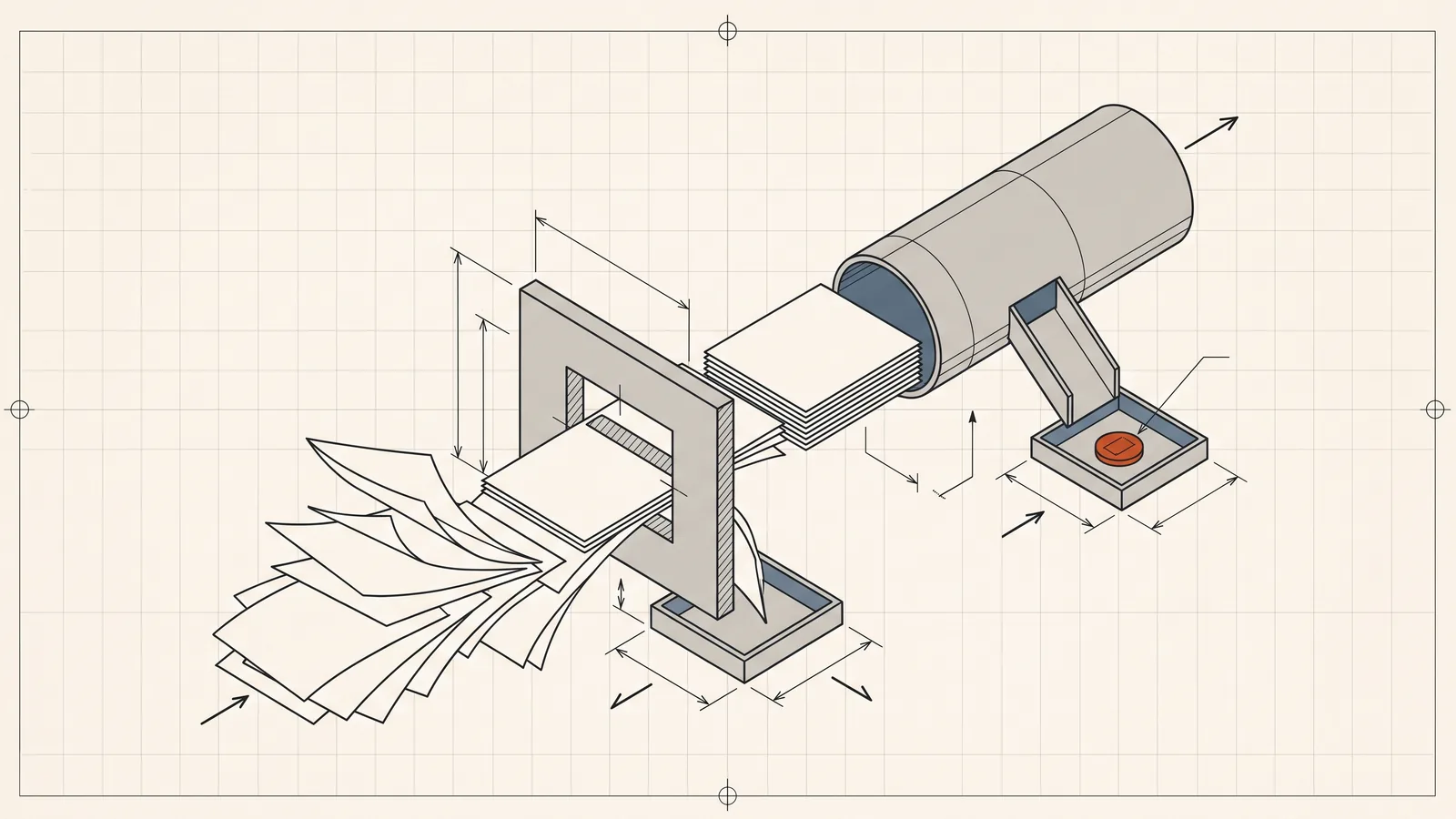
The dividing line runs between what the model decides and what the code produces. The model reads intent, so "wystaw fakturę Acme za kwiecień" resolves to a client, a period and an amount. Everything downstream is deterministic: the FA(3) XML is built by a schema-bound builder, JPK_V7M and JPK_EWP are generated against their published structures, ZUS and ryczałt come out of a rate table for the year, not out of a prompt. If a value can be checked against a schema or an official rate, the model does not get to author it.
Submission is treated as a first-class capability rather than an export button. Sending to KSeF means an online session, the send, the wait and retrieval of the UPO; filing through the Ministry gateway means implementing its hybrid AES plus RSA encryption and collecting the receipt. Both paths were exercised end to end against the sandbox, because a system that generates a file the user still has to upload by hand has automated the easy half.
Costs are handled where the paperwork actually gets stuck: purchase invoices arrive as photographs and PDFs. OCR runs on a multimodal model locally, on CPU, with a hosted small model as fallback, and the result feeds the expense register with a per-item VAT deduction percentage, so partial deduction, the familiar fifty percent on a car used privately as well, ends up in the right JPK field rather than in a note.
Functionality is packaged as skills, discrete capabilities with their own scripts and tests, which is what makes it possible to say precisely what has been verified. The README carries a status table checked against the codebase, listing what is shipped, what is documentation only and what is missing outright, with file paths as evidence. Overdue-payment alerts are on that table as missing, and they stay listed as missing.
Outcome
The project is public under MIT with around a hundred and eighty tests, with KSeF submission, the ministry gateway and invoice generation verified end to end against sandbox environments. Repository: github.com/dithiothreitol/jdg-ksiegowy. It replaces the core of a paid SaaS subscription for the case it targets, while the data stays on the user's own machine and the model can be local.
The limits of the project are worth stating. It is beta, it targets ryczałt rather than every tax form a JDG can choose, and the regulatory surface moves: KSeF schemas, JPK structures and ZUS rates all change on someone else's calendar, so maintenance is not optional and the honest measure of the project is how fast it tracks those changes.
What it taught me
The useful pattern for AI in a regulated process is narrow and boring: let the model handle intent and ambiguity, let deterministic code produce anything that will be validated by somebody else. The moment a model authors a value that a schema or a tax authority will check, you have built a system that is confidently wrong at unpredictable intervals.
The second lesson is about honest status. A feature table that lists what is missing, with paths a reader can grep, is worth more to a potential user than any amount of description, and it is the same discipline that makes an architecture document trustworthy.