Context
Grzybiarz is my own product: a mobile application that helps a forager spot fruiting bodies in forest litter, and assists in identifying a species by comparing it against the toxic species it can be confused with. It is under development, with a launch targeted for autumn 2027; several subsystems are finished and running, and the on-device vision pipeline is the part still being closed.
Problem
Two constraints shape everything, and both are unusual.
The forest has no mobile signal at all, and the accurate word is none rather than poor: the moment the product needs a server to answer, it is useless exactly where it is used. So inference, the map, the species reference and the whole session record have to live on the phone.
The second constraint is that the accuracy bar is set by the domain rather than by taste. Several edible species have lookalikes that differ in details a single photograph may not even capture, and the difference matters. That rules out the ordinary shape of a consumer AI feature, in which a model returns its best guess with a percentage next to it and the interface lets the percentage stand in for knowledge.
There is a third constraint that only appears once foragers are involved. Nobody shares where they pick mushrooms. A social feature that publishes locations is a feature nobody will switch on, and one that quietly publishes them is a betrayal.
Approach
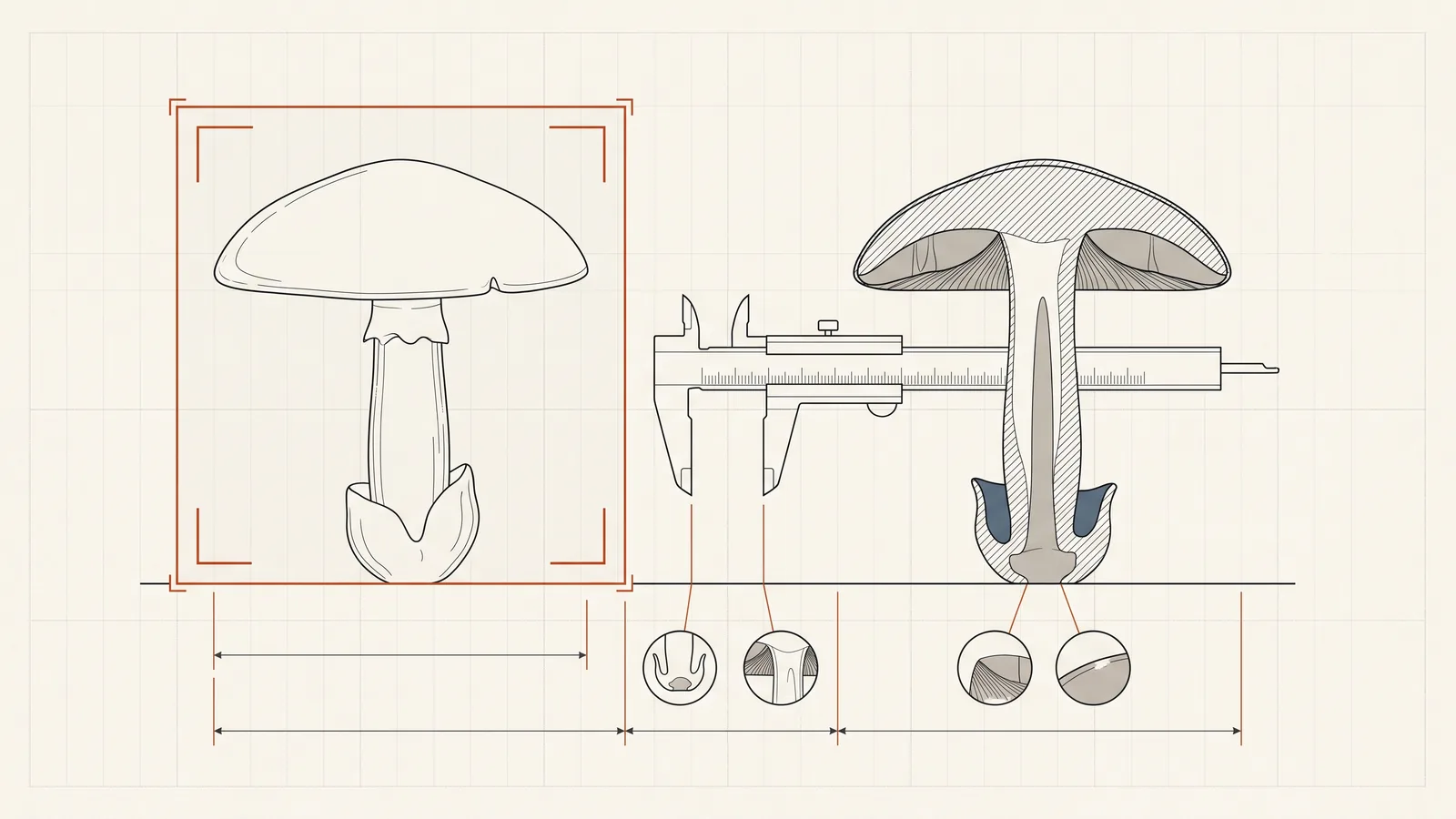
The product is positioned as an assistant, not an oracle, and that is enforced in the architecture rather than in a disclaimer. Every identification is shown with a calibrated confidence, alongside the toxic species it can be confused with and the morphological checks that separate them, dig up the stem base and look for a volva, check the gill colour. The reference data is built for exactly this: about a hundred and twenty-five species and a hundred and thirty confusion pairs, each with the distinguishing features written out and a severity marking so the most serious ones are treated differently in the interface. The model narrows the question; the person answers it, holding the mushroom.
Calibration is treated as a feature: temperature scaling, an explicit reject option and out-of-distribution detection, so that "I do not know" is a first-class output rather than a low bar on a chart. A photograph of something the model never trained on has to fail loudly, not land on the nearest species.
The on-device pipeline produced the most instructive engineering result. Quantising the detector to INT8 would have halved the model, and it does not work here: the head emits boxes, confidences and mask coefficients concatenated into one tensor, so they share a quantisation scale. The pixel-valued boxes force a step of roughly 2.5, and every confidence in the zero-to-one range then rounds to zero. That was measured on the exported graph, not assumed, and the answer was to ship fp32 with a smaller backbone rather than a quantised model that returns nothing.
Privacy was designed around what foragers actually do. There are no accounts: identity is anonymous, with a recovery code hashed with Argon2id and burned on first use, implemented as a Keycloak SPI so the backend still has one identity provider rather than a homemade one. GPS is stripped from photo EXIF before the file is stored. A find shared publicly is jittered by up to two hundred metres server-side and reduced to an H3 hex cell, so the community map shows where the season is running without showing anyone's spot.
Outcome
What is finished and running: the foraging session subsystem with GPS tracking, background capture and personal records; fully offline Polish maps through MapLibre and PMTiles; the local database; the community backend on Quarkus with anonymous authentication; and about thirty cross-platform screens shared between the mobile and web applications. Around eleven hundred TypeScript tests and a Java test suite cover it.
What is not finished, and should be said plainly, is the part the product is named for. The detector and classifier are integrated and building on device, the export toolchain is decided, and the frame-rate acceptance measurement on physical hardware is still outstanding. A vision feature that has not been measured on a real phone in real light is a plan, not a capability.
What it taught me
In a domain where the user makes the final call, the useful question is not how to raise accuracy but what the system does when it is unsure. An abstention that is designed, calibrated and visible is worth more than several points of top-1 accuracy, because the user's decision is the one that matters and the interface either supports it or replaces it.
The second lesson is narrower and cost me time: quantisation is not a setting. It is a numerical decision about a specific graph, and it has to be measured on that graph. Mine failed for a reason nothing in the documentation would have warned me about.