Context
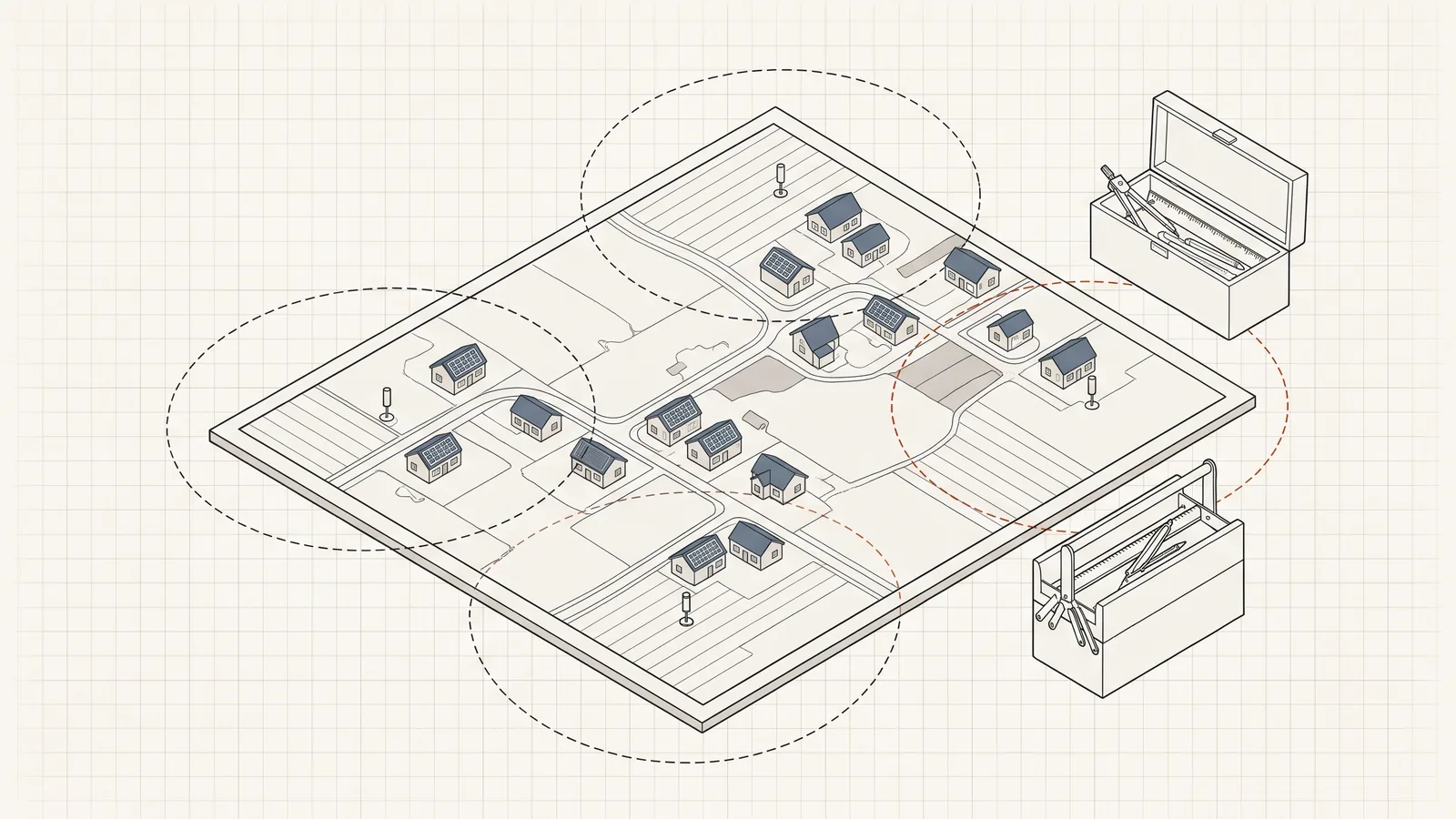
A client in the renewable energy market wanted a platform with two audiences. Homeowners looking for a photovoltaic system, an energy storage unit or a heat pump find a local installation crew on a map and run the project with them in one place. Crews get a lightweight CRM, a calendar, an investment room shared with the client, a catalogue of wholesale prices and access to formal services such as grid operator applications and subsidies. One website, one mobile application for both roles, one backend.
Problem
A map of crews is worth exactly as much as its density. A homeowner uses such a platform a few times in a lifetime, so the value they find depends on crews having registered, kept their profiles current and answered enquiries quickly. Crews do none of that for a tool they open when a lead arrives once a month. A plan that starts with the homeowner's journey, map, profile, contact, and leaves the crew's daily tools for later delivers an empty map with a polished search box.
My first plan did roughly that: the price catalogue sat in phase six of a plan running to phase eight. The client read the plan item by item and called that a product mistake, because price alerts were the reason a crew would open the application every day. The client was right, and the correction changed the order of the whole build.
The second difficulty was that the business process could not be closed up front. The client said plainly that project statuses would be refined with real users: a request for specific photographs before installation, equipment in transit, uploading the post-installation documents. A pipeline hard-coded from the first specification would have been wrong within a month.
Approach
The catalogue, manual promotions, product watches and price alerts moved into the core of the MVP, ahead of the investment room. The crew's dashboard became the centre of the application, opening with alerts computed from existing data rather than stored: an enquiry unanswered for 46 hours, two people waiting for a call, a site audit at four, an inverter a few hundred złoty cheaper, a protocol missing in an investment. Each alert disappears when its cause does and links to the place where it gets resolved.
Price alerts are where correctness costs most, because a wrong alert teaches people to ignore the right ones. Only verified offers from active sources can trigger them. Each kind of alert, a price threshold, a promotion ending, a new offer, a new promotion, a price drop, keeps its own cursor over first approvals, so opting in never replays history and a re-approved offer never fires twice. When one offer matches both a product watch and a category watch, the user gets one notification. Delivery goes through an outbox written in the same transaction as the business change, and the delivery job rechecks the offer, the watch and the user's channel preferences before sending, so a failing push provider never rolls back an approval and a withdrawn offer never reaches a phone.
Statuses are data. The code knows the phases and four anchor statuses; everything in between lives in tables an administrator can change, seeded with every status the client listed. The photo request got its full data model at once, while its detailed experience was explicitly deferred until there was something to test it on.
Two decisions came from the crews themselves. They work in Polish, Ukrainian and Russian, so the installer side ships in those languages, with Cyrillic font subsets and a translation parity check in CI. And a crew's base is often someone's home, so the public projection carries only a display point, never the address or user identifiers. Search measures the real base against both the radius and the declared coverage and returns distance rounded to half a kilometre, and public pages are rendered without a result cache, so hiding a profile or a moderation decision takes effect on the next request. An empty search result is never padded with illustrative crews.
The platform reuses the architecture of an earlier marketplace I had delivered: the same identity pattern, upload pipeline and shared cross-platform screens. Where that earlier codebase stated rules it did not actually follow, I settled each one explicitly, for example by putting every access decision in one policy class instead of hundreds of per-method annotations.
Outcome
Five weeks after the start, the foundation phase is closed and the remaining eight are partly implemented: company verification and crew publication, search and contact, a CRM with tasks and reminders, the catalogue with five kinds of price alerts, the investment room with conversation, documents, photo requests and formalities, and the administration panel. The project documentation states plainly that "implemented" means code and described tests, not production readiness. Device tests of the camera and push notifications, production keys for payments and SMS, and the launch itself are still ahead.
What it taught me
In a two-sided platform, the side that comes back every day is the product and the side that comes once is distribution. The order of the build should follow the side that has to return.
The second lesson concerns plans. The most valuable review of this architecture came from a client reading a plan concrete enough to disagree with, down to the phase in which the catalogue lived. A vaguer plan would have survived that reading and failed later, in use.