Context
A manufacturing group ran its project work and part of its commercial pipeline on a commercial platform covering tasks, boards, Gantt charts, time tracking, budgets, a CRM, workflow automation, a chat, a wiki, client ticketing and guest access. Most of the organisation used a fraction of it, and the fraction differed by department.
Problem
Replacing a mature commercial product with an internal module invites the failure everybody has seen. The comparison is drawn feature by feature, every gap looks like a risk, the scope expands to close the gaps, and two years later the organisation maintains a worse version of something it used to rent.
The build only makes sense if the answer to some of those features is a permanent no, recorded with a reason, rather than a place on a roadmap. Deciding that is uncomfortable, because each exclusion is an argument with whoever asked for it.
Approach
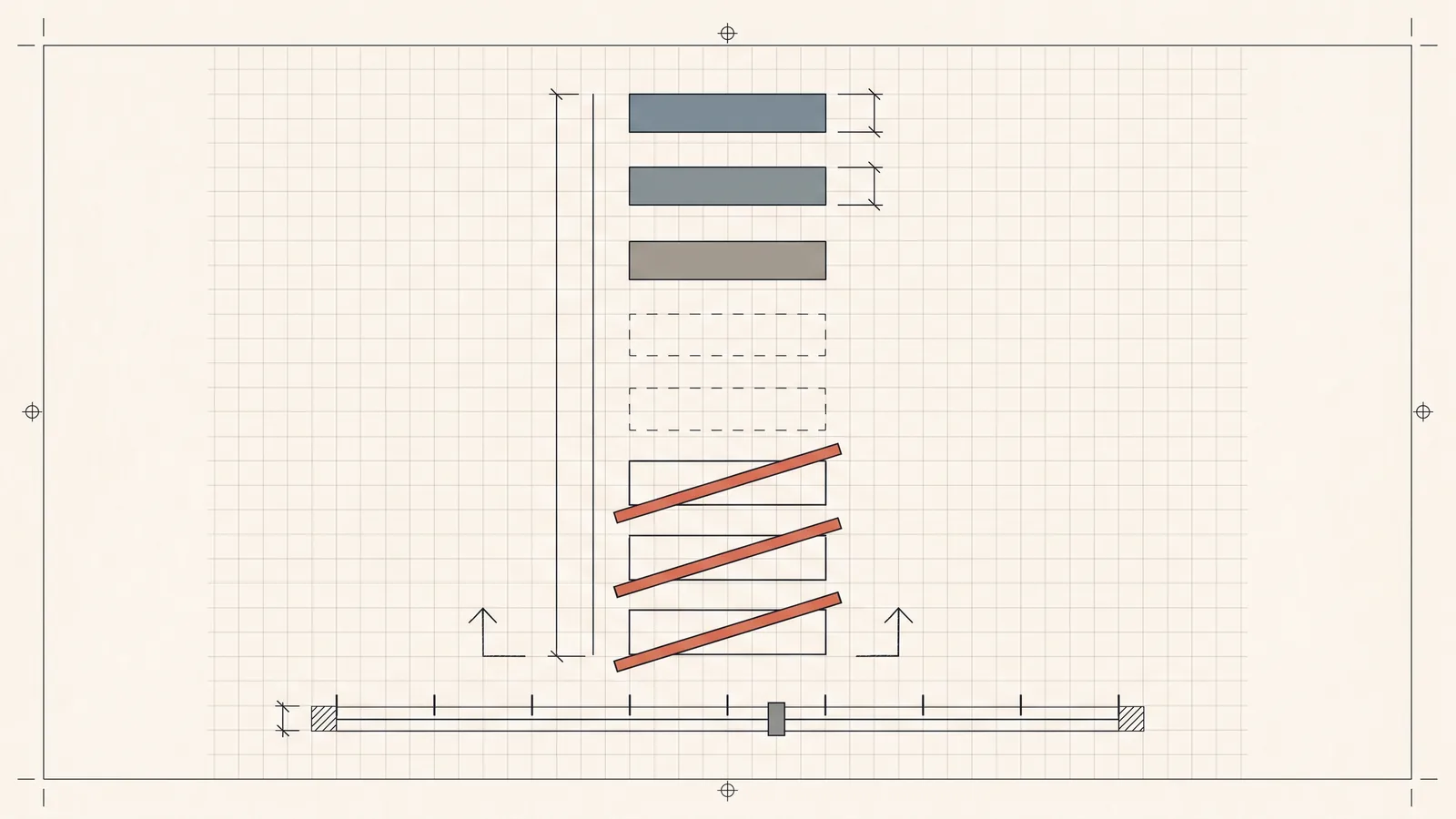
The incumbent product was benchmarked area by area, and each row of the table received one of three answers: in the first release, in a later one, or never. The third column is the one that made the project viable.
Chat is excluded permanently, because the company already has communication channels and a project tool that adds a fourth place to write a message makes conversations harder to find rather than easier. Absence management is excluded permanently, because it belongs to the HR domain and lives in the system that owns employment data. Client ticketing and a wiki sit in the later column with the conditions for revisiting them written down. Custom fields were declined in the first release with a JSON column as an explicit escape hatch, which is the honest version of that decision: the need is real, the editor is expensive, and the escape hatch says so instead of pretending the need does not exist.
What was built covers tasks with configurable states, boards and timelines, cycles, time tracking by timer and by hand, budgets and profitability computed from tracked time against rates, a capacity view built from facts rather than estimates, a lightweight CRM of accounts, contacts, deals and activities, a workflow rule engine and project templates.
Process metrics are the part that would be hard to buy. State transitions are written to an append-only log, and flow metrics are computed from it rather than sampled, so cycle time and throughput describe what happened rather than what the board looked like when somebody exported it. That log reuses the hash-chained audit pattern already established across the estate.
The AI features run through the shared assistant platform rather than being built here: a status reporter that drafts a project update, and natural language queries answered against published read-only views. The pattern holds as it does elsewhere, with the model summarising and querying while the numbers come from the views.
The module reuses the platform underneath it in full, with its own schemas beside the existing ones, the established audit chain, the shared identity provider, the shared component library for the new front end, and the deployment pattern the operations team already runs.
Outcome
Project and CRM become a module of the internal platform rather than a separate subscription, with the data sitting beside the recruitment, document and planning data that projects actually touch, and with the excluded features excluded on record so the conversation does not restart every quarter.
What it taught me
A build-versus-buy decision is usually presented as a comparison of capability and cost, and it is better understood as a question about scope discipline. An internal build wins where an organisation is willing to use less, and it loses wherever the internal version is asked to match a commercial product feature for feature.
The second lesson is that an exclusion needs a reason attached to survive. A feature marked as out of scope will be requested again within a quarter, and the only thing that makes the second conversation short is a written reason that somebody can either accept or argue with directly.